Construction Site Generator Sizing
Construction tools utilize electric motors which have special startup power requirements. When a motor starts, it uses up to six times the rated power for one and a half to three seconds. A generator starting that motor must be capable of supplying the motor’s inrush current during startup. If multiple tools will operate from the generator at the same time, consider the starting current of each motor.
Power tool motors fall into two categories: the universal motor and the capacitor start motor. Universal motors power easy to start tools such as electric drills, circular saws, disc grinders and jig saws. The number of starting watts for each tool is approximately double the number of run watts. Each tool has a nameplate marked with the voltage and the amps and should also include the LR or LRA. Multiply amps by volts for watts, then double the number of watts to determine starting watts.
Tools that use capacitor start motors are shown on the nameplate as type G or type L motors. These include table saws, brick or metal cut-off saws, air compressors, and pumps. Running watts are determined by multiplying volts by amps as shown on the tool nameplate. Type G motors require three times the running watts to start; type L motors need six times the running watts at startup.
Example: An air compressor with a type G motor draws 10 amps at 120 volts or 1200 watts. 1200 watts x 3 = 3600 starting watts.
Example: A circular saw runs a universal motor at 12.5 amps. 120 volts x 12.5 amps = 1500 watts. The starting watts is 1500 x 2 = 3000 watts.
If multiple tools will operate at the same time, total up the running watts for all the tools, then add the highest starting watts to the total running watts. Two or more type G motors that start and stop frequently (air compressor, table saw, etc) may require a generator that can start two or more motors at the same time.
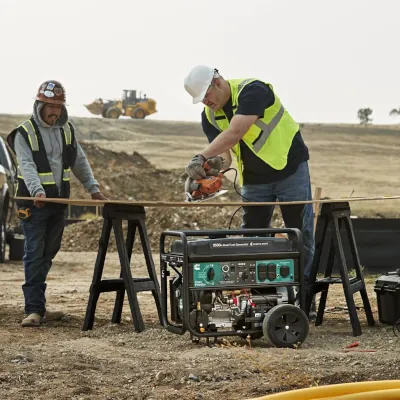
Example: A construction site has two workers using circular saws and a 1 horsepower air compressor. The compressor runs at 1200 watts, but needs 3600 watts to start. The two saws run at 1500 watts and need 3000 watts each to start.
Running Watts Required: 1500 + 1500 + 1200 = 4200 Running Watts.
Starting Watts Required: 4200 + 3600 = 7800 Watts.
The minimum generator capacity for this job site is 4200 running watts and 7800 Starting watts. However, when all three motors are running, the generator is working at maximum capacity. Add a 25 percent margin and the generator won't work quite so hard.
4200 Watts + 1050 Watts (25% margin) = 5250 Watts
Pick a generator with 7800-8000 Starting Watts and at least 5200 Running Watts. That way, the generator doesn't run at maximum capacity which will extend its life.
One important feature on a contractor generator is a low idle. With low idle, anytime the power use falls to zero, the generator engine slows down to use less fuel, reduce wear and tear, and as a bonus, make less noise.
Need more information? Pick The Best Portable Generator for Contractors and Job Sites
Kubuta Liquid Cooled Diesel Generators
Sizing Generators for Recreational or Emergency Use
How to size a portable generator: Make a list of the appliances the generator will power at the same time. Total the running watts for all except the device with the highest starting watts. Then add in the highest starting watts. Add 25% to the total to prevent the generator from running at maximum capacity. This works for both recreational and emergency use, such as during a power outage. If two or more motors start often, like a sump pump during a rainstorm, add the starting watts for both instead of the running watts.
Starting Watts vs Running Watts
Generator Volts Amps and Watts
Example Portable Generator Load
| Appliance | Running Watts | Starting Watts |
|---|---|---|
| Sump Pump | 500 | 1700 |
| Well Pump | 1050 | 3200 |
| Furnace Fan | 600 | 1600 |
| Toaster | 1100 | 1100 |
| Refrigerator | 800 | 1900 |
| Hair Dryer | 1800 | 1800 |
*This is only an example. Check your appliances
and do your own calculations.
In this example, the heaviest load is the Well Pump, but it could be a central air conditioner. The highest load for RV applications is usually one or more air conditioners.
In our portable generator sizing example, the well pump has the highest starting watts (3200 watts) of all the appliances. First, we total the running watts of all appliances except the well pump.
- Sump Pump + Furnace + Toaster + Refrigerator + Hair Dryer = 500 + 600 + 1100 + 800 + 1800 = 4800 Watts.
Next, we add the starting watts of the well pump.
- Other Appliances + Well Pump = 4800 + 3200 = 8000 Starting Watts. This is the minimum starting watts the generator must supply.
Find Total Running Watts
- Other Appliances + Well Pump Running Watts = 4800 + 1050 = 5850 Running Watts
Finally, we add our 25% margin to prevent overloads or overworking the generator.
- 5850 Running Watts + 25% = 5850 + 1452 = 7312 Running Watts.
It's a good idea to build some margin into the starting watts as well. Check the Pro Tip below for the reason why.
We go to the Portable Generator for Home Backup Category at Norwall to find a generator. The Generac GP7500E DF catches our eye. With 7500 running watts and 9400 starting watts, it meets our requirements of a 7300 running watts and 8000 starting watts with a little extra margin. The 1400 additional starting watts is a bonus because we won't worry about two heavy loads starting at the same time.
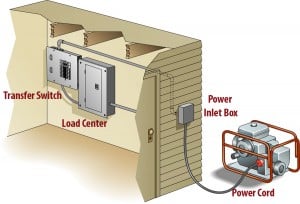
Hardwired appliances like a furnace, well pump, or central air conditioner can't plug into a generator outlet. To use these appliances, a Manual Transfer Switch for a Portable Generator powers your hardwired circuits. A single Generator Cord between the generator and the house plugs into an inlet box, eliminating or reducing the number of extension cords required.
Pro Tip: You must consider your heavy starting loads carefully. If you have two or more heavy loads likely to start at the same time, the generator starting watts should cover both loads. In a real world example, a refrigerator and 12000 BTU window air conditioner were running on generator power in addition to other appliances. With a total load of about 4000 watts, the 5500 watt generator had no trouble running the refrigerator and air conditioner most of the same time, but the generator breaker tripped regularly. The cause was the air conditioner compressor starting at the same time as the refrigerator. At 3100 starting watts (A/C) and 1900 starting watts (fridge), the combined total starting load of over 7000 watts was too much for the generator. The generator breaker tripped to protect the generator and the appliances. Having the extra starting watts margin as shown in the above example could prevent this scenario.
Pick the Best Portable Generator for Camping and Tailgating
*Generator Sizing Guides are for estimating purposes only. Actual power requirements of high demand appliances vary widely by brand, model and capacity. Always have an authorized dealer or qualified electrician analyze your specific requirements before making a purchase decision.
Related: Buyer Guide: What Size Portable Generator Do I Need
Read Next |> Planning a Manual Transfer Switch Installation (1/4)