
Generator Interlock Kit vs Transfer Switch

When the power goes out, your portable generator can provide power for your most critical appliances. We need heat in the winter, cooling in the summer, our sump pumps must always work, and medical equipment should always be available. The fridge and freezer should stay cold, and a few lights and internet would be nice too.
The only way to power hard-wired appliances like a furnace or air conditioner with a portable generator is through your circuit breaker panel. Backfeeding your panel through an appliance outlet is dangerous and illegal. Don’t do it.
Never allow utility power and generator power to interact or come together. Most likely, the interaction will permanently damage your generator. In some cases, mechanical failure can lead to property damage, injury, or even death. Backfeeding can allow utility power to meet generator power. It can also feed the utility lines during an outage, endangering utility workers and your neighbors.
There are two options for bringing power from your generator to the circuit breaker panel—a manual transfer switch or an interlock kit. Both are safe, but they operate differently. There are advantages to both, and some disadvantages as well. Before you decide which to use and install, it’s important to understand the differences, advantages, and disadvantages. Let’s dig into the details of the transfer switch vs interlock options.
How to Power Your Home with a Portable Generator
Manual Transfer Switch
A transfer switch “transfers” power from one source to another. “Manual” means it requires the operator to physically move the switch between sources as needed.
The Homelink Manual Transfer Switches sold by Norwall are well-suited for portable generator backup applications. They transfer all three lines of the 240-volt supply: Line 1, Line 2, and Neutral. This is important for safe operation of most portable generators as a separate source of electrical power. The Homelink switches are considered load centers because they contain the circuit breakers that receive power from the generator or from the main circuit breaker panel.
Most manual transfer switches receive power from a double-pole circuit breaker in the main panel during normal operation, and from the generator during an outage.
Installation includes adding a 30-Amp or 50-Amp circuit breaker in the main panel to feed the manual transfer switch. The breaker amps rating must match the manual transfer switch amps rating. Within the manual transfer switch is a circuit breaker for each circuit the switch will provide power, both during a power outage and for normal operation. This design limits the number of circuit breakers and circuits they control. It also allows the electrician to balance the load on the generator by equally distributing 15 amp and 20 amp breakers on lines 1 and 2.
During an outage, when the generator is running and the transfer switch is in the generator position, all of the circuits controlled by the switch receive power. Any circuit not in the switch will not receive power. This is where the transfer switch vs interlock debate originates.
Manual Transfer Switch vs Interlock Pros & Cons
| Pros | Cons |
|---|---|
|
|
Planning a Manual Transfer Switch Installation
Interlock
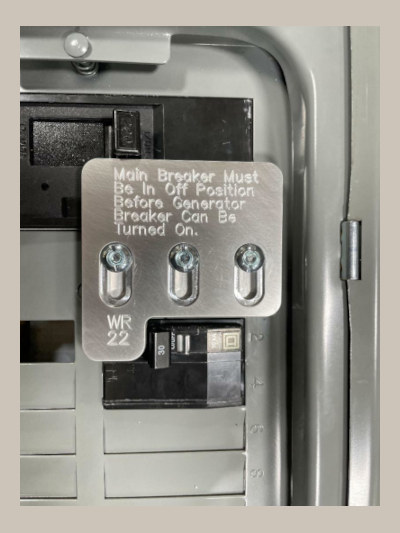
Instead of a separate panel (the manual transfer switch,) the interlock allows the generator to supply the main panel much like the utility does. A circuit breaker in the panel connects to the generator through an inlet box. When the interlock circuit breaker is on, power from generator flows through the interlock breaker into the main panel. This is also true of utility power. It flows through the main circuit breaker into the main panel whenever the main breaker is on.
A mechanical connection between the main circuit breaker and the interlock breaker prevents both from being in the “On” position at the same time. Either the main breaker is on or the interlock breaker is on, never both. This arrangement satisfies the rule that utility power must never meet generator power. It also prevents generator power from ever leaving the home’s electrical system and backfeeding the utility lines.
In a typical installation, the homeowner must turn the breaker in use to the off position, slide a plate that blocks the other breaker switch from moving, and then turn the other breaker to the on position. Both breakers can be off, but they can never be on at the same time.
This arrangement allows the generator to power any circuit in the home. It also makes it very easy to overload the generator or force an unbalanced load and possibly cause the generator damage.
| Pros | Cons |
|---|---|
|
|
An interlock between the main breaker (top) and the generator breaker (bottom) prevents both circuit breakers from being in the on position at the same time. To turn the generator breaker on, you first turn off the main breaker, slide the interlock up, and then turn on the generator breaker.
Transfer Switch Importance for Home Generators
Generator Ground and Your Generator Interlock or Transfer Switch
Your portable generator for home backup will need a 120/240-Volt outlet to work with either the generator interlock or transfer switch. The two most common receptacles are either 120/240-volts 30-amps (L14-30R) or 120/240-volts 50-amps (14-50R).
You must be aware of the neutral wire and ground and ground connection. Most portables suitable for supplying a house have the neutral bonded (connected) to the generator frame—usually referred to as a bonded neutral. When this generator connects to the home through a transfer switch, the frame of the generator must connect to a ground rod or other suitable grounding electrode. The Homelink transfer switches sold by Norwall are 3-pole switches that connect and disconnect the neutral (between the switch and the main panel, and the switch and generator) allowing the generator to act as a separately derived system.
With an interlock switch, the main panel already bonds neutral to ground. In this case, you should disconnect the generator’s neutral to frame bond for safety. The NEC only allows the neutral-ground bond in a single location.
- Manual Transfer Switch: Neutral-Ground bond at the generator, generator frame connected to a ground rod or grounding electrode.
- Generator Interlock: Neutral-Ground bond in the main-panel or main disconnect, no additional bond or grounding needed.
If you already own a generator, determine if it has a bonded neutral or floating neutral. Some manufacturers provide the means to add or remove the bond. Generators manufactured with a floating neutral usually have a ground terminal that allow you to add a ground rod. With the generator off and nothing plugged into it, perform a continuity test between any receptacle neutral slot and the generator frame. Continuity indicates a bonded neutral.
You can still bond neutral to ground even if the generator does not come with the means to do. Purchase a ground plug and plug it into any 120-volt outlet. The plug connects the neutral to ground. Then use the ground terminal on the panel to add a grounding electrode. The ground plug is inexpensive.
Portable Generator Grounding - What You Need to Know
Know Your Power Limits - Interlock vs Transfer Switch
The limited number of circuits that receive power from the transfer switch make it very unlikely you will accidentally overload your generator. During the installation, the electrician will balance the load so that each line of the 120/240 volt source carries an equal share of the load. A balanced load ensures the wires from the generator never carry more current than they should.
On the other hand, the interlock makes power available to ALL the circuits in the main panel. This sets up a scenario where it becomes possible to overload the generator or overload the wires to the generator. An unbalanced load occurs when either Line 1 or Line 2 carry a disproportionate share of the total load.
Overloaded wires will overheat and could cause a fire. Overloaded generator coils will overheat and cause permanent damage to the generator.
For example, you have a 30-amp air conditioner, a 40-amp electric water heater, and 20-amp well pump, in addition to all the other circuits in your home. The power goes out and you hook up the generator. Then you move the interlock to the generator position and turn on the breaker. At first, the generator handles the load.
Then someone gets in the shower. The well pump turns on, and maybe the generator struggles a little, but it still handles the load. The water heater senses the water temperature dropping, so it turns on and click. Your entire home is dark.
Hopefully, the interlock breaker or the generator’s main circuit breaker did their jobs and protected the generator and the wiring.
The interlock REQUIRES you to manage your power.
- You must know the generator’s power limits.
- You know the power requirements of the circuits you choose to run on generator power.
- You must keep the load on the generator balanced.
Keeping the load balanced while selecting the circuits you need may not be simple. Sometimes, it’s not even possible. You need to know which circuits connect to each side of 120/240-volt supply within the main panel, and then balance the load by selecting circuits from both side to power with the generator. It's okay if one side is 5-10 amps higher than the other side, but a higher difference and you risk the unbalanced condition.
Understanding Generator Volts, Amps, and Watts
Making a Choice: Interlock Kit vs Transfer Switch
Choosing a manual transfer switch vs an interlock comes down to convenience, knowledge, and capability.
For most people, the manual transfer switch is the way to go. It is more convenient, and you don’t have to choose which circuits to turn on or off while standing in the dark with a flashlight. During installation, your electrician will help you choose which circuits to power with your generator transfer switch and will keep the load as balanced as possible.
The manual transfer switch is the safest, fastest, and easiest way to connect your portable generator to your home’s electrical system.
If everyone in the home understands how to connect the portable generator and turn off all the breakers not in use while keeping the load balanced, the interlock may be the best choice. It gives you little more flexibility. You could, for example, turn off the kitchen outlet and turn on a bathroom outlet to use a hair dryer.
If you choose the interlock option, it is still a good idea to decide which circuits you will power during a power outage. Mark those circuits and possible alternates for easy reference. Ask your electrician to balance the load on those circuits and allow you to make a few substitutions if necessary. For example, if you want a choice between the bathroom outlet and the kitchen outlet, they should be on the same leg of the 120/240-volt source, but you understand to only use one at a time.