
Guide to Choosing the Best Generator for Motorhomes, RVs, or Camping
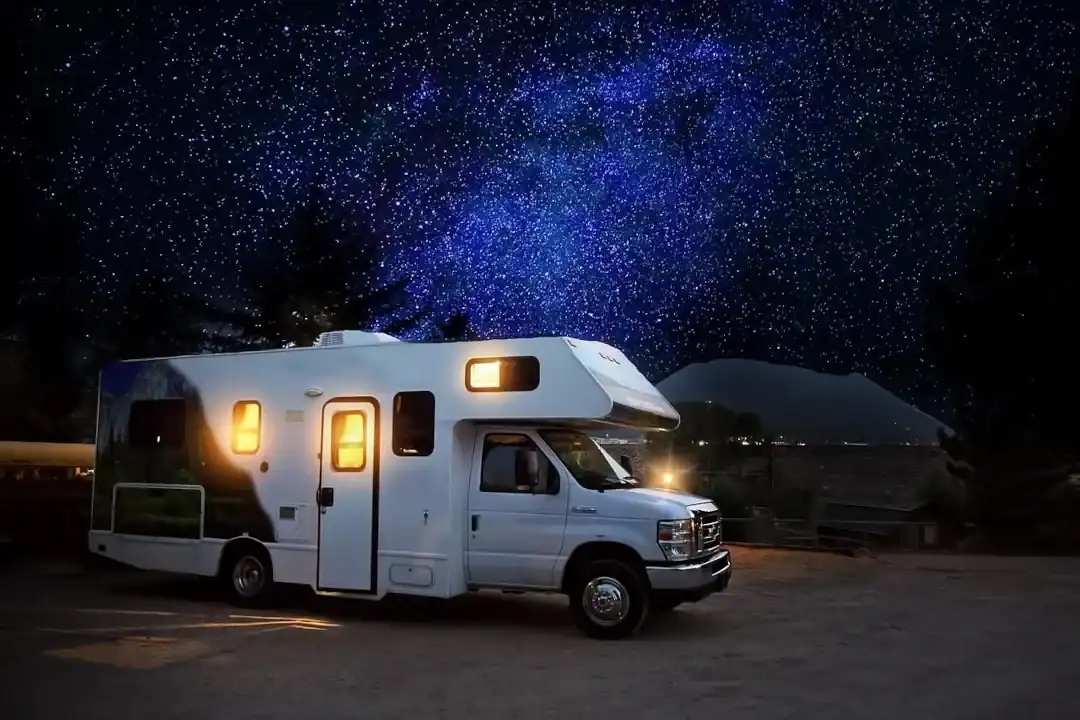
The right power source depends on your application. Tent or van camping seldom requires a lot of power. Travel trailers and fifth wheels need more power, and some require more power than others. The largest motorhomes have power needs that rival mid-sized homes.
Key is matching the right type of power source to your RV or camping style.
Generator Power Criteria That Matter for All Applications
Running Watts vs Starting (Max) (Surge) Watts: All devices that use power place a steady, continuous load on the power source. A great example is a lightbulb. An LED light might require 10-15 watts, while the same amount of light from an incandescent bulb requires 75 watts. Some appliances and tools with electric motors have a starting requirement that requires 2-3 times more power than the continuous load. We call the starting power requirement Starting Watts or Max Watts.
Starting Watts vs Running Watts
Conventional / Traditional Generator: A conventional generator outputs power directly from the alternator. Depending on the quality of the alternator and other components, the power quality varies from excellent (low distortion) to poor (highly distorted). Traditional generators operate at a constant speed to generator a consistent frequency, 3600 RPM for 60 Hertz. Portable generators with an open frame make a lot of noise. Onboard RV generators in an enclosure are quieter than open-frame portables.
Inverter Generator: An inverter generator uses a fuel-efficient variable-speed engine and alternator to produce variable frequency current, which is converted electronically to direct current (DC) and then converted again to alternating current at a precise frequency. Models enclosed with a solid case can be exceptionally quiet, as low as 51 dB noise measured at 23 feet. The engine speed changes with the electrical load, making the inverter generator exceptionally fuel efficient.
Inverter Generator vs Regular Generator: What is the Difference?
Noise Levels: As mentioned above, fully enclosed inverters produce less noise than open frame portables. The lowest comes in around 48 dB. Ultra quiet models at 50-54 dB. Average runs between 50-62 dB. Traditional portables range from 68 dB to 75 dB, with some models reaching 80 dB or higher. You won't find yourself welcome at campgrounds or parks with a loud generator.
Noise Level Comparisons
| Sound Level | Compares To |
|---|---|
| 50 dB | Rustling leaves Moderate rainfall Quiet conversation at home |
| 55 dB | Quiet outdoor neighborhood Electric fan Quiet background music |
| 60 dB | (National Park Service Requirement at 50 feet.) Office noise Inside of car at 60 MPH Running Dishwasher |
| 65 dB | Normal conversation in a restaurant Busy Office Car passing by on a residential street |
| 70 dB (Caution) | Vacuum cleaner Washing machine Loud talking |
| 75 dB (Caution) | Air conditioner on high Busy Restaurant Hair Dryer on High |
| 80 dB (Caution) | Garbage disposal Heavy city traffic Diesel Truck at 40 MPH |
| 85 dB (Threshold) | (Extended exposure may damage your hearing) Food Blender Noisy Open Office Space |
| 85+ dB (Harmful) | Lawn Mower 90 dB Motorcycle 95 dB’ Chainsaw 100 dB Snowmobile (110 dB) Rock Concert (120 dB) |
Tip: Unofficially, the usual distance for measuring generator sound levels is 23 feet. Manufacturers or testers take multiple measurements from many sides and usually publish the lowest value.
Generator Noise Levels—How Loud Are They?
Run Time and Fuel Type: Generators for RVs and camping run on diesel, gasoline, or propane. Dual fuel models give you flexibility with a choice between gasoline and propane. There is one steadfast and unbreakable rule—the more power you use, the more fuel you are going to use. Larger generators have larger engines and use more fuel. Two common measurement points for run time and fuel consumption are 50% load and 25% load. 50% is a good target for continuous daytime use, and up to 75-80% is acceptable for long periods. Larger fuel tanks mean longer run time.
Some small portable inverter generators provide more than 20 hours of run time at 25% rated load. The new onboard RV inverter generators sip less fuel than their predecessors. Nearly every manufacturer cites their generator’s fuel use and run time in the specifications.
Weight and Portability: For portables, weight is a big factor and impacts portability in a big way. The small inverter generators for camping can weigh less than 50 pounds. Larger portables for travels trailers and fifth wheels weigh up to a one hundred or a little more. Wheels and extendable handles make moving easy. Carry handles are fine for the small models.
Parallel Capability: Another advantage of inverter generators is parallel operation. Parallel generators combine the power of both. Maybe you don’t need full power all the time. Running a larger generator uses more fuel and makes more noise, even when you need less power. With parallel generators, you can run one when power needs are low, and two when the need is high. Two smaller generators are easier to load, store, and move than one large generator.
Altitude and Temperature Derating: The higher you go and the hotter it gets, the less power a generator can provide. If you spend a lot of time in the mountains or the desert, it’s worth adding a bit of power to your purchase consideration.
30-Amp RV versus 50-Amp RV: The difference is like night and day.
A 30-amp RV requires a single 120 volt line at up to 30 amps.
(120 volts x 30 amps = 3600 watts.)
A 30-Amp connection is 1 hot line, 1 neutral line, and 1 ground.
30-Amp RVs have their own outlets (TT-30R) and plugs (TT-30P) for shore power and generator connections.
A 50-amp RV requires two (2) 120-volt lines, each carrying up to 50 amps.
(120 volts x 50 amps x 2 lines = 12000 Watts)
A 50-Amp connection is 2 hot lines, 1 neutral, and 1 ground.
A 50-Amp or 30-Amp connection does not mean you will use or need all that power, only that the RV wiring requires that type of connection. Size your generator appropriately to the needs of your RV.
Note: Parallel kits for an inverter generator have 30-amp or 50-amp outlets for 120-volts only. The 50-amp outlet provides 120-volts at up to 50-amps on both hot lines. The outlet cannot provide 240 volts because the two lines are “in phase” with each other. Don't try to run a 240-volt appliance or tool from a generator parallel kit UNLESS you have 240-volt inverter generators connected in parallel with a 240-volt parallel kit. 120-volt generators cannot provide 240 volts with a standard parallel kit.
RV and Camping Generator Sizing
The basis for sizing a generator is determining your running watts requirement by adding up the appliances that use power. You will find that many appliances list volts and amps, but not watts. No problem, multiply volts x amps = watts.
Take all your large appliances, A/C, microwave, refrigerator, hair dryer, etc. and add up their running watts. Now add the starting watts for the heaviest load. Buy a generator with a running watts rating that is higher than your total running watts and a starting watts rating higher than your required starting watts (appliance running watts + starting watts).
Key Takeaway to Choosing the Right Size RV Generator
- Total the running watts of all the appliances that could run at the same time.
- Note the largest surge. This is usually a large appliance with a motor, like a standard size refrigerator, or a second or third air conditioner starting when the other air conditioner(s) are already running.
- Total running load must fit within the generator’s running watts capacity.
- The largest surge must also fit the generator’s starting watts capacity.
- Don’t forget to add 10-15% margin.
Example Calculation for 1 air conditioner, refrigerator, microwave, and Crock Pot.*
Running Watts = A/C watts + Fridge Watts + Microwave + Crock Pot + 25%.
= 1500 Watts + 80 Watts + 1000 Watts + 150 Watts + 25%
= 2730 Watts + 25% = 3412 Watts
Starting Watts = A/C Starting Watts
= 1800 Watts – 1500 Watts = 300 Additional Watts.
= Running Watts + 300 Additional Watts
= 3412 + 300 = 3712
*This is an example, don’t leave out your other appliances or medical equipment.
Note: Sometimes, it is likely that two or more heavy loads might start at the same time. If this is the case, add the difference between starting watts and running watts for each to the Starting Watts requirement.
Trailer and Fifth-Wheel RVs
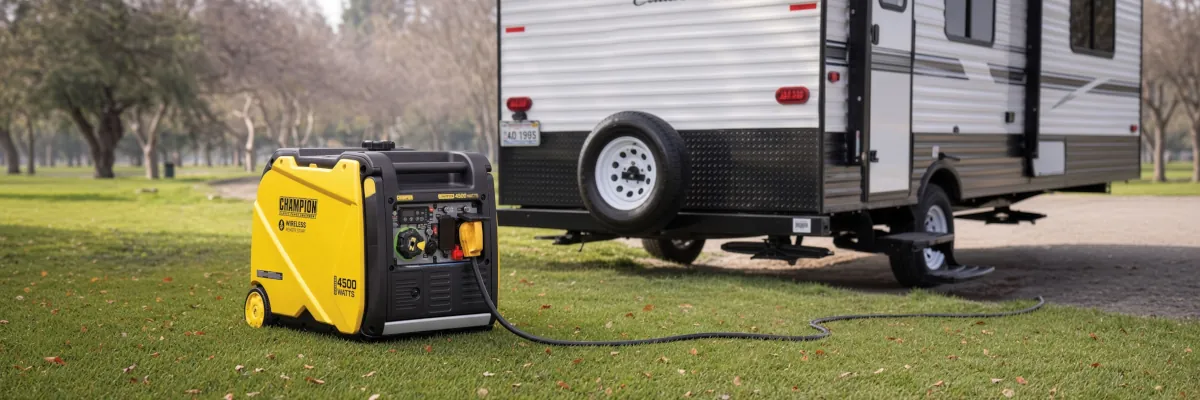
Note: If your Fifth Wheel or Travel Trailer dealer prepped your RV for an onboard generator, go to the Class A / Class C Motorhomes section below.
Start with the air conditioner(s). The two most common sizes are 13500 BTU and 15000 BTU.
13500 BTU AC: 1800 Starting Watts, 1500 Running Watts.
15000 BTU AC: 3000 Starting Watts, 2000 Running Watts.
For a 30-Amp RV, a 13500 BTU or higher air conditioner automatically pushes you to a 3600 watt minimum, and a little higher won’t hurt. Two portable inverter generators in parallel, each with 1900-2100 running watts will handle this load with ease. A 4000 running watts onboard generator is a great fit here.
Travel Trailer and Fifth Wheel RV Generators
Top Pick: Champion 4500 Watt Inverter Generator with Remote Start and RV Ready Travel Trailer Outlet. The Champion 4500 generator is parallel ready with moderate noise levels around 61 dB. Rated at 3500 running watts and 4500 starting watts. At 25% load, one tank of gas provides up to 18 hours run time.
Quieter: The Cummins 4500 Watt Inverter Generator P4500i with Remote Start and RV Travel Trailer outlet brings noise levels down as low as 52 dBA. The Cummins 4500 generator is parallel ready. Rated at 3700 running watts and 4500 starting watts. At 25% load, one tank of gas provides up to 14 hours run time.
Class A / Class C Motorhomes
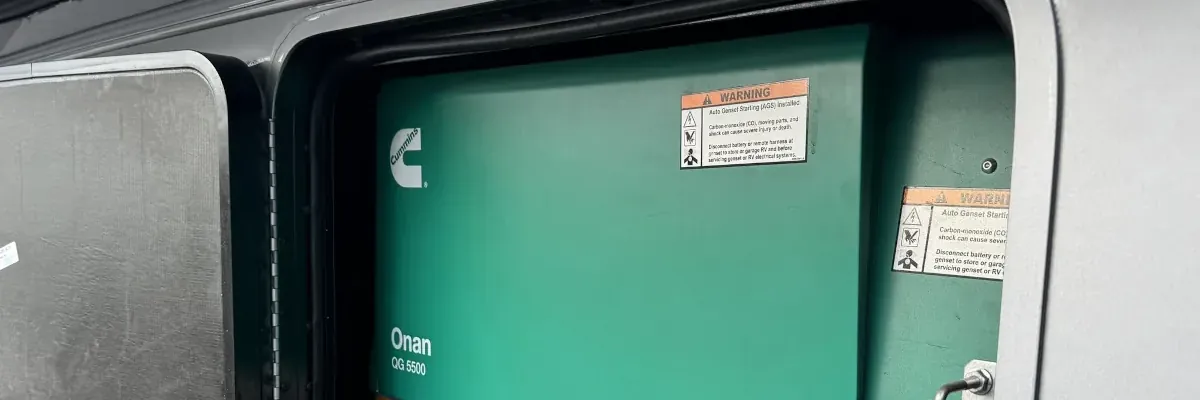
Two or three air conditioners, residential-size refrigerators, larger house batteries, full-size microwave ovens, clothes washing and drying machines, and more add up to a lot of power.
Motorhomes come prepped for an onboard generator. Take a look at the specifications for your onboard generator and match the new model closely to the old one. If your power needs have increased, purchase a larger generator to meet the increased requirements.
Typical sizes for motorhomes range from 2500 watts for small Class C models to 12000 watts for the largest luxury coaches.
Top Pick: The Cummins Onan 7000 Watt Onboard RV Generator (Dual Fuel LP or Gasoline) with less than 1.5% Total Harmonic Distortion produces clean power safe for the most sensitive electronics and appliances. At 7000 Watts, it's a good choice for a rig with a pair of 15000 BTU air conditioners. It meets Park Service requirements for noise at just 60 dB measured at 50 feet. Typical Installation in an RV compartment lowers the noise level even more.
Smaller Motorhomes: The Cummins Onan 4000 Watt EVAP Generator (Gasoline. An Onan 3600 Watt LP Generator is available) is a popular choice for smaller RV motorhomes and prepped fifth-wheels or travel trailers. At 4000 watts, it easily powers a single air conditioner with plenty of power to spare. This generator also meets Park Service noise level requirements.
Cummins Onan also offers Onboard Diesel RV Generators from 3200 to 12000 Watts
Be sure to check out the Onboard RV Generators from NPS and RVMP.
Camping Generators for Tents, Vans, or Pop-ups
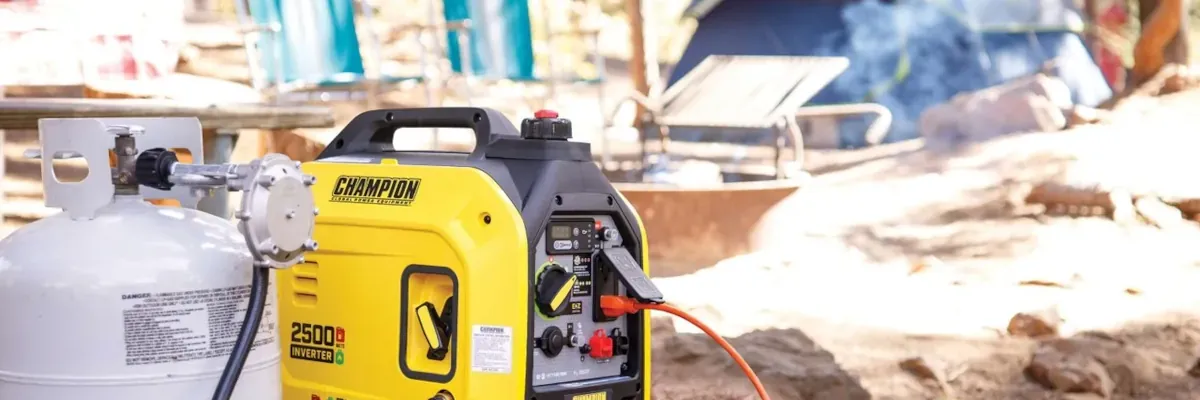
Choosing a generator for your tent, van, or pop-up camper is much like choosing a generator for your motorhome or RV. Add up the running watts of everything you want to power, add in additional starting watts, and that is the generator size.
Camping generators are the lightest load category. No rooftop A/C in most cases, except maybe vans, and those are small units. Possible loads include:
- Portable refrigerator/cooler (30-60 Watts continuous)
- Fan
- CPAP machine at night
- Small coffee maker
A small portable inverter generator is almost as perfect as it gets for this purpose. The coffee maker is the biggest load at 600-900 watts. Any model with 1900-2200 running watts is all you need.
Top Pick: The Champion 2500 Watt Dual Fuel Inverter Generator is light (43 pounds), quiet (53 dBA), and runs for up to 25 hours on a standard 20-pound propane tank. At 1665 Watts on propane, it has all the power you need for charging electronics, brightening up the campsite with strings of LED lights, or keeping your CPAP going through the night AND run your fan. Make coffee in the morning and plug in a crock pot in the afternoon. The camping uses are endless.
The Solar Option: No Gas - No Fumes - No Noise
There are places that prohibit or limit generator use. Some people would rather not hear the noise or carry fuel. It’s a personal choice that makes good economic and ecological sense.
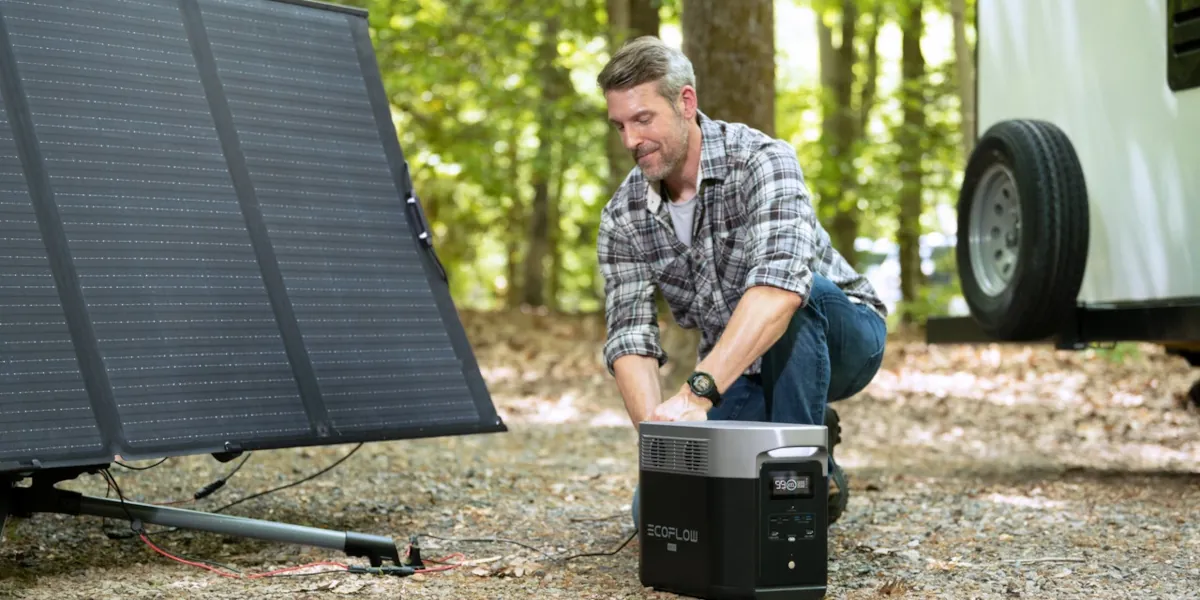
The portable power station, sometimes called a solar generator or battery generator, is a no-fuel no-noise minimal-impact solution. In a nutshell, the energy stored in a power station’s rechargeable battery converts to electrical power that you can use. Power stations have similar specifications to generators, with one major difference; A generator converts the energy stored in fuel into mechanical energy and then into electrical energy. A power station converts energy stored in a battery into electrical energy.
Power station specifications list battery storage capacity in watt-hours. Like running watts and starting watts, energy storage capacity is an important specification you should understand.
Watts is a measure of electrical power. If we turn on a 1000-watt heater, we are using 1000 watts of power. We often express watts as W, as in 1000W.
Watt-hours is a measure of energy, either stored or used. If we use a 1000-watt heater for 1 hour, we have used 1000 watt-hours of energy. 1000 watt-hours = 1000Wh.
If we plan to use a power station for 24 hours, we need to know how much energy we are using for that 24 hours. This is where planning differs from a generator.
Energy Use for 24 Hours:
- CPAP machine, 8 hours, without heat/humidification 30W x 8 hours = 240Wh.
- Fan for 8 hours = 75W x 8 hours = 600Wh.
- Portable Refrigerator 40W Intermittent for 24 hours = 500Wh.
- Small Coffee Maker for 1 Hour = 600Wh.
- Charge 2 cell phones 30Wh.
Total Energy Used: 1970 watt-hours.
For one day, we need a power station that provides at least 1970Wh of energy storage. And if we’re camping for more than a day, we must charge the battery or add enough storage for each day. Storage is expensive and heavy, but solar is a good alternative, and there are portable solar panels available from 100 to 400 watts.
A 400W solar panel in full sun will charge a 2000Wh power station in about 5-6 hours.
Provided you have the sunlight, a portable power station makes sense. 12 hours of daylight provides between 4-6 hours of usable sunlight for solar charging.
Final Word on How to Choose the Right Generator for RVs, Motorhomes, or Camping
Don't try to skimp and buy a generator or power station that just barely covers your need. Making do with less power, especially if you're used to using power without managing it, is more trouble than most people want when they are trying to relax. And, it's usually not practical to shut the refrigerator off so you can run the microwave.
Calculate your power requirements—it's not hard—and then buy a generator or power station with a 20-30 percent margin.
Do your maintenance on time according to the owner manual. Neglecting maintenance is the number one cause for generator failure. Check oil daily, top off as necessary, and change it when the manual says to change it.